📊 Full opportunity report: Retirement Care Planner on IdeaNavigator AI — validation score, market gap, and execution plan.
Open a free Amazon Business account
Business pricing, bulk buying and tax-exempt orders.
Create a free accountAs an affiliate, we earn on qualifying purchases.
TL;DR
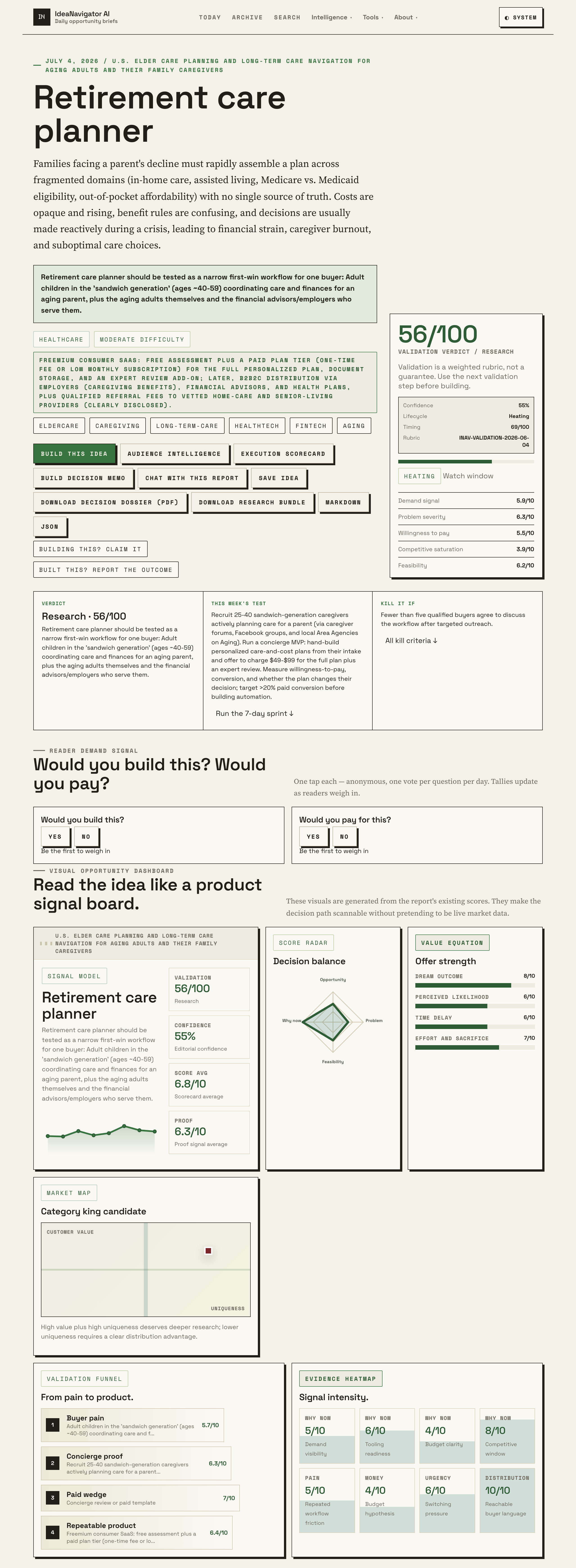
A retirement care planner prototype is being tested to assist adult children in the ‘sandwich generation’ with care and financial decisions for aging parents. The tool aims to provide personalized care plans based on local costs and eligibility, responding to rising elder care costs and complexity.
A new retirement care planning web app prototype is currently in testing, targeting adult children in the ‘sandwich generation’ who are managing care and finances for aging parents. This development addresses the urgent need for structured guidance amid rising elder care costs and complex benefit rules, offering a personalized, localized plan based on family circumstances.
The proposed tool is designed to assist families facing the challenge of coordinating care options such as in-home aides, assisted living, and nursing homes, while navigating Medicare and Medicaid eligibility. It aims to generate a tailored plan after a brief intake process, including local cost comparisons, benefit explanations, and an affordability projection. The initial focus is on a single high-cost state to manage data complexity.
According to IdeaNavigator AI, the prototype will be offered as a freemium SaaS product, with a free assessment and a paid tier providing a comprehensive personalized plan, document storage, and optional expert review. The service will also include a referral network for vetted local providers. Validation efforts involve recruiting 25-40 caregivers actively planning for a parent, offering a concierge version of the service for $49-$99, and measuring willingness to pay, plan impact, and decision changes.
Addressing the Growing Elder Care Planning Gap
This development is significant because it responds to an urgent demographic and economic challenge. With approximately 73 million Americans projected to be 65+ by 2030 and nearly 70% of those turning 65 likely to need long-term care, families face mounting costs and decision complexity. The tool aims to reduce caregiver burnout, improve decision quality, and potentially lower costs by providing structured, personalized guidance. It also introduces a scalable approach to elder care planning that could reshape how families and providers coordinate care.
As an affiliate, we earn on qualifying purchases.
Rising Costs and Complexity in Elder Care
Over recent years, elder care costs have surged — assisted living median costs now reach about $6,200 per month, and nursing home semi-private rooms average approximately $115,000 annually. Meanwhile, the U.S. population is aging rapidly, with the ‘sandwich generation’ increasingly burdened by caregiving responsibilities alongside their careers and families. Currently, most families rely on reactive decision-making during crises, often leading to financial strain and suboptimal care choices. The proposed care planner seeks to shift this dynamic toward proactive, informed planning.
As an affiliate, we earn on qualifying purchases.
Uncertainties About Adoption and Effectiveness
It is not yet clear how widely families will adopt the prototype or how effective it will be in changing decision outcomes. The validation phase will measure willingness-to-pay and whether the tool influences actual care choices, but broader adoption and long-term impact remain uncertain at this stage.
in-home elder care assistance devices
As an affiliate, we earn on qualifying purchases.
As an affiliate, we earn on qualifying purchases.
Next Steps for Validation and Expansion
The immediate next step is to complete the validation with the recruited caregiver sample, refining the prototype based on feedback. Success metrics include achieving over 20% paid conversion and demonstrating that the plans lead to better-informed decisions. If validated, the developers plan to automate the tool, expand to additional states, and pursue partnerships with employers, financial advisors, and health plans to scale distribution.
medicare and Medicaid planning tools
As an affiliate, we earn on qualifying purchases.
As an affiliate, we earn on qualifying purchases.
Key Questions
How will the retirement care planner determine local costs?
The planner will use public benchmark data for local costs of in-home care, assisted living, and nursing homes, tailored to the family’s location.
Is this tool intended for all families or just certain groups?
The initial focus is on adult children in the ‘sandwich generation’ actively planning for aging parents, especially in high-cost states, with potential expansion to broader demographics.
Will the planner handle Medicaid and Medicare eligibility details?
Yes, the tool aims to explain eligibility rules and help families understand their options based on their specific circumstances.
How will the service generate revenue?
Through a freemium model offering paid plans, expert reviews, and referrals to vetted providers, plus potential B2B partnerships with employers and financial firms.
What are the main challenges in developing this tool?
Key challenges include accurately modeling local costs, integrating benefit eligibility rules, and ensuring user trust and engagement during the validation phase.
Source: IdeaNavigator AI
Flea & tick season Picks
flea and tick prevention
As an affiliate, we earn on qualifying purchases.