For most shoppers, the Drive Medical 2-Button Standard Foldable Walker is the best overall starting point: its straightforward folding design suits people who want a conventional walker without extra moving parts. The Vive Mobility Narrow Frame Walker stands out for tighter spaces, while the Medline Folding Paddle Walker may appeal to people who prefer a different folding control. The main tradeoffs are compactness versus walking-room, and fixed glides versus wheels that roll more easily across some floors. Check fit, hand strength, and the surfaces where the walker will be used before choosing. Read on for the full comparison and buying advice.

Turn quiet afternoons into listening time
- Thousands of audiobooks, podcasts and originals
- Listen on your phone, tablet or Echo — also offline
- Cancel anytime
Complete the kit


Key Takeaways
- The standard two-button design is the clearest all-purpose choice: Drive Medical’s basic model favors simple folding over added features.
- A narrow frame can solve a real space problem: Vive Mobility’s 9.5-pound narrow option is the standout for tight indoor routes, though a narrower fit is not right for every user.
- Folding controls differ in how they may suit the user: the Medline paddle and Drive trigger-release designs offer alternatives to pressing two separate buttons.
- Wheels and ski glides change how the walker moves: several picks combine 5-inch wheels with rear glides, a setup aimed at easier forward movement than a fixed-leg walker.
- Similar listings call for close specification checks: multiple Medline and Vive models have overlapping names, so verify the exact frame, controls, dimensions, and capacity before ordering.
| Drive Medical 2-Button Standard Foldable Walker, Silver |  | Best for Stable, No-Wheel Support | Material: Aluminum | Color: Silver | Folding mechanism: Two-button push-button operation | VIEW LATEST PRICE | See Our Full Breakdown |
| Vive Mobility Lightweight Folding Walker for Seniors, Narrow Frame, 9.5 lb |  | Best for Tight Indoor Spaces | Weight: 9.5 lb | Weight capacity: 300 lb | Frame material: High-strength aluminum | VIEW LATEST PRICE | See Our Full Breakdown |
| Vive Mobility Lightweight Folding Walker for Seniors, 9.5 lb |  | Best for Ready-to-Use Convenience | Weight: 9.5 lb | Weight capacity: 300 lb | Frame material: High-strength aluminum | VIEW LATEST PRICE | See Our Full Breakdown |
| VEVOR Folding Walker with 2-Button Quick Fold and 8-Level Height Adjustment |  | Best for Broad Height Adjustment | Material: Aluminum | Height adjustment: 8 levels, 32.3–39.4 inches | Folding mechanism: 2-button quick fold | VIEW LATEST PRICE | See Our Full Breakdown |
| Lightweight Folding Walker with Front Wheels for Seniors |  | Best for Shorter Users Who Want Front Wheels | Frame material: Aircraft-grade aluminum alloy | Height adjustment: 30.7–37.4 inches; 8 locking positions | Recommended user height: 5.4–6.6 feet | VIEW LATEST PRICE | See Our Full Breakdown |
| Medline Folding Paddle Walker with 5-Inch Wheels |  | Best for Hands-on Folding | Frame material: Alloy steel and aluminum | Height range: 32.5–39.5 inches | Folded width: 5 inches | VIEW LATEST PRICE | See Our Full Breakdown |
| Medline Lightweight Two-Button Folding Walker with 5-Inch Wheels |  | Best Lightweight Pick | Frame material: Aluminum | Walker weight: 6 pounds | Weight capacity: 300 pounds | VIEW LATEST PRICE | See Our Full Breakdown |
| Drive Medical Trigger Release Folding Walker with Contoured Hand Grips |  | Best for Contoured Grip Comfort | Frame material: Brushed steel aluminum | Handle height: 32–39 inches | Inside hand grip width: 18 inches | VIEW LATEST PRICE | See Our Full Breakdown |
| Medline Two-Button Lightweight Folding Walker with 5-Inch Wheels |  | Best for Higher Weight Capacity | Frame material: Steel | Listed weight: 6.5 pounds in description; 7 pounds in item details | Weight capacity: 400 pounds | VIEW LATEST PRICE | See Our Full Breakdown |
| Loyoda Folding Walker with 2 Skis and 5-Inch Wheels |  | Best for Replaceable Ski Glides | Design: Folding walker | Wheel size: 5 inches | Feet: Round feet pre-installed; replaceable with ski glides | VIEW LATEST PRICE | See Our Full Breakdown |
| Folding Walker for Seniors with 5-Inch Wheels and Ski Glides, 350 lb Capacity |  | Best for Surface Flexibility | Frame material: Reinforced aluminum alloy | Weight capacity: 350 pounds | Wheel size: 5 inches | VIEW LATEST PRICE | See Our Full Breakdown |
| X8 Walker for Seniors – Folding Walker with 2 Skis and 5″ Wheels |  | Best for Buyers Who Want Listed Certifications | Frame material: Reinforced aluminum alloy | Weight capacity: 350 pounds | Wheel size: 5 inches | VIEW LATEST PRICE | See Our Full Breakdown |
| folding walkers for senior | Weight capacity | Frame material | Wheel size | Folding mechanism |
|---|---|---|---|---|
| Drive Medical 2-Button Standar | — | — | — | Two-button push-button operation |
| Vive Mobility Lightweight Fold | 300 lb | High-strength aluminum | 6 in | — |
| Vive Mobility Lightweight Fold | 300 lb | High-strength aluminum | 6 in | — |
| VEVOR Folding Walker with 2-Bu | 350 lb | — | — | 2-button quick fold |
| Lightweight Folding Walker wit | 300 lb | Aircraft-grade aluminum alloy | — | — |
| Medline Folding Paddle Walker | 300 pounds | Alloy steel and aluminum | 5 inches | Trigger release |
| Medline Lightweight Two-Button | 300 pounds | Aluminum | 5 inches | Two-button, independent side folding |
| Drive Medical Trigger Release | — | Brushed steel aluminum | 5 inches | Trigger release |
| Medline Two-Button Lightweight | 400 pounds | Steel | 5 inches | Two-button, independent side folding |
| Loyoda Folding Walker with 2 S | — | — | 5 inches | — |
| Folding Walker for Seniors wit | 350 pounds | Reinforced aluminum alloy | 5 inches | Trigger release |
| X8 Walker for Seniors | 350 pounds | Reinforced aluminum alloy | 5 inches | One-hand trigger release |
More Details on Our Top Picks
Drive Medical 2-Button Standard Foldable Walker, Silver
I’d choose the Drive Medical 2-Button Standard Foldable Walker for someone who wants a straightforward frame that stays planted rather than rolling ahead. Its four rubber-tipped legs and U-shaped frame provide a stable base, while the cross-frame design leaves room for a more natural approach to the walker. The aluminum build and push-button folding make it easier to store or load into a vehicle than a rigid frame. Compared with the Vive Mobility Lightweight Folding Walker, Narrow Frame, this Drive model has no wheels or hand brakes, so each step involves lifting and repositioning it. That can suit users who prefer fixed contact with the floor, but may be tiring for frequent walking. Its height adjusts, though the product data does not give a specific range.
Pros:- Four rubber tips provide floor contact at each leg
- Aluminum frame keeps the walker lightweight
- Two-button folding supports storage and transport
- Adjustable height and U-shaped clearance accommodate everyday use
Cons:- No wheels means the user must lift and reposition the frame with each step
- Described as intended for light outdoor use, limiting its appeal for frequent outdoor walking
Best for: Seniors who want a foldable, non-wheeled walker for steady indoor support and occasional short trips.
Not ideal for: People who find lifting a walker tiring or need rolling assistance for longer walks; consider a wheeled option such as the Vive Mobility narrow-frame walker.
- Material:Aluminum
- Color:Silver
- Folding mechanism:Two-button push-button operation
- Maximum user weight:350 lb
- Frame:U-shaped with improved cross-frame design
- Leg tips:Four rubber tips
- Height:Adjustable
- Wheels:None
Our verdict“Choose this Drive Medical model if you want a simple folding walker with four fixed rubber feet and do not mind lifting it as you walk.”
Vive Mobility Lightweight Folding Walker for Seniors, Narrow Frame, 9.5 lb
The Vive Mobility Narrow Frame Walker is the strongest fit here for users who need to maneuver through cramped rooms or narrow passages without giving up wheels. Its 9.5-pound aluminum frame folds in one step and locks for carrying or storage, while the open design leaves space for a more natural stride. The 6-inch wheels and hand brakes add rolling control across indoor flooring and varied outdoor surfaces. Compared with the Drive Medical 2-Button Standard Walker, the Vive is easier to roll forward but does not provide four stationary rubber feet. It also lacks a seat and rear bars, so it is a mobility aid rather than a place to rest. The 33–39-inch handle range may rule it out for users whose fit falls outside that span.
Pros:- 9.5-pound frame and one-step locking fold simplify transport
- Narrow, open design supports maneuvering in tight spaces
- Adjustable handles, ergonomic grips, and hand brakes support fit and control
- Six-inch wheels are designed for indoor and varied outdoor surfaces
Cons:- Handle height is limited to 33–39 inches
- No seat or rear bars are included
- Rolling wheels may not suit users who prefer a walker that stays planted between steps
Best for: Seniors who walk through narrow indoor spaces and want a lightweight wheeled frame with hand brakes.
Not ideal for: Users who need a seat, a fully enclosed rear frame, or handle height outside the 33–39-inch range.
- Weight:9.5 lb
- Weight capacity:300 lb
- Frame material:High-strength aluminum
- Handle height:33–39 in, adjustable
- Wheel size:6 in
- Folding:One-step folding with locking system
- Frame design:Narrow, open frame
- Assembly:Pre-assembled
- Guarantee:Lifetime frame guarantee
Our verdict“Pick the Vive narrow-frame model if tight-space maneuverability and rolling control matter more than a seat or fixed-leg stability.”
Vive Mobility Lightweight Folding Walker for Seniors, 9.5 lb
This Vive model suits buyers who want a pre-assembled, 9.5-pound walker with a quick fold and rolling support, without spending time on setup. Its narrow open frame is designed for smaller spaces, and the 6-inch wheels, adjustable handles, ergonomic grips, and hand brakes offer more control than a basic no-wheel walker such as the Drive Medical 2-Button Standard Walker. It shares its listed core specifications with the Vive Mobility Narrow Frame Walker, including the 33–39-inch handle range and 300-pound capacity, so the choice between those two listings is not a meaningful difference in stated function. The tradeoff is a spare design: no seat is described, and the open rear does not offer the same enclosed frame feel some users may want.
Pros:- Pre-assembled design reduces setup work
- 9.5-pound aluminum frame folds in one step for transport
- Narrow open frame is suited to small spaces
- Six-inch wheels and hand brakes support controlled movement
Cons:- No seat is specified
- Handle height range may not fit every user
- 300-pound capacity is lower than the 350-pound capacity listed for the Drive Medical and VEVOR models
Best for: Seniors or caregivers who want a pre-assembled, lightweight wheeled walker for indoor use and occasional trips outside.
Not ideal for: Users who need a seat, a rear crossbar, or handle adjustment beyond 33–39 inches.
- Weight:9.5 lb
- Weight capacity:300 lb
- Frame material:High-strength aluminum
- Handle height:33–39 in, adjustable
- Wheel size:6 in
- Folding:One-step folding with locking system
- Frame design:Narrow, open frame
- Assembly:Pre-assembled
- FSA/HSA eligible:Yes
Our verdict“Choose this Vive listing for a ready-to-use, narrow wheeled walker, provided its handle range and 300-pound capacity suit the user.”
VEVOR Folding Walker with 2-Button Quick Fold and 8-Level Height Adjustment
The VEVOR stands out among these folding walkers for its eight height settings across a stated 32.3–39.4-inch range. That gives caregivers more adjustment points than the Drive Medical model, whose height is adjustable but has no range listed, and may make it easier to dial in a comfortable fit. Its 350-pound capacity matches the Drive while exceeding the 300-pound limit listed for both Vive models and the front-wheel walker. Two-button folding keeps the frame practical to store, and anti-skid feet favor a planted stance rather than rolling. The tradeoff is that no wheels are specified, so the user may need to lift and reposition it with each step. Its height range also has a lower limit of 32.3 inches, which may not suit shorter users.
Pros:- Eight height levels across a stated 32.3–39.4-inch range
- 350-pound weight capacity
- Two-button quick fold supports storage and transport
- Anti-skid feet provide a planted contact point
Cons:- No wheels are specified, so repositioning may require lifting
- Height adjustment does not extend below 32.3 inches
- The listed specifications do not include an overall walker weight
Best for: Seniors and caregivers who want a non-wheeled walker with multiple height settings and a 350-pound capacity.
Not ideal for: Users who need wheels to avoid lifting the frame, or whose suitable handle height falls outside 32.3–39.4 inches.
- Material:Aluminum
- Height adjustment:8 levels, 32.3–39.4 inches
- Folding mechanism:2-button quick fold
- Tube wall thickness:1.25 mm
- Weight capacity:350 lb
- Feet:Anti-skid
Our verdict“Choose the VEVOR if a wide set of height adjustments and higher stated capacity matter more than wheels or a lightweight rating.”
Lightweight Folding Walker with Front Wheels for Seniors
This front-wheel walker has a useful combination for buyers who want easier forward movement but still want rear contact from anti-slip sled pads. Its one-hand folding button may be simpler to operate than the two-button VEVOR walker, and eight height positions cover a stated 30.7–37.4 inches. That lower starting point sets it apart from the Vive models, whose handles begin at 33 inches, though the listed recommended user height is 5.4–6.6 feet and should be checked against the individual’s fit. The 5-inch front wheels are smaller than the Vive’s 6-inch wheels, and the frame supports up to 300 pounds rather than the 350 pounds listed for the Drive and VEVOR. It arrives 80% assembled, so some setup remains.
Pros:- One-hand folding button supports easier folding
- Eight height positions span 30.7–37.4 inches
- Front wheels pair with anti-slip rear sled pads
- Soft rubber handles and rust-resistant aluminum alloy frame
Cons:- 300-pound capacity is lower than the Drive Medical and VEVOR models
- 80% pre-assembled, so setup is still required
- Recommended user height is limited to 5.4–6.6 feet
Best for: Seniors who want front wheels with rear sled-pad contact and need height settings starting below 33 inches.
Not ideal for: Users above 300 pounds, people outside the stated 5.4–6.6-foot recommended height range, or buyers who need a fully assembled walker.
- Frame material:Aircraft-grade aluminum alloy
- Height adjustment:30.7–37.4 inches; 8 locking positions
- Recommended user height:5.4–6.6 feet
- Weight capacity:300 lb
- Front wheel size:5 inches
- Base width:26 inches
- Folding:One-hand button with locking mechanism
- Assembly:80% pre-assembled; no tools required
Our verdict“Pick this model if you want front wheels, rear sled-pad contact, and a height range that starts lower than the Vive walkers’ range.”
Medline Folding Paddle Walker with 5-Inch Wheels
The trigger release is the main reason I’d choose this Medline: it lets a user fold the walker without taking their hands off the grips, which can make stowing it simpler for someone who finds small buttons difficult. It folds to 5 inches wide, a useful fit for a car trunk or a narrow storage spot. Compared with the Medline Lightweight Two-Button Folding Walker, this model prioritizes its paddle-style release rather than independent side folding. Its 5-inch wheels and height adjustment add everyday flexibility, but the recommended user height is limited to 5 feet 5 inches to 6 feet 4 inches. The 300-pound capacity is also lower than the capacity listed for the steel Medline two-button model. I’d treat its stated lower-leg-injury recovery focus as a fit clue, not a substitute for clinician guidance.
Pros:- Trigger release allows folding without letting go of the handles.
- Folds to 5 inches wide for compact storage and transport.
- Height adjusts from 32.5 to 39.5 inches.
- 5-inch wheels support movement across a range of everyday surfaces.
Cons:- Recommended user height excludes many shorter adults.
- 300-pound capacity is lower than the listed capacity of the Medline two-button steel model.
- Its recovery-oriented description may not match every user’s mobility needs.
Best for: Adults 5 feet 5 inches to 6 feet 4 inches who want a walker that folds using a trigger release without removing their hands from the grips.
Not ideal for: Shorter adults, users who need a capacity above 300 pounds, or buyers seeking the independent side-folding action of a two-button walker.
- Frame material:Alloy steel and aluminum
- Height range:32.5–39.5 inches
- Folded width:5 inches
- Wheel size:5 inches
- Weight capacity:300 pounds
- Recommended user height:5 feet 5 inches to 6 feet 4 inches
- Handle grip width:17 inches
- Folding mechanism:Trigger release
Our verdict“Choose this Medline if a hand-on-grip trigger release and narrow folded profile matter more than a broader height fit or higher capacity.”
Medline Lightweight Two-Button Folding Walker with 5-Inch Wheels
At a listed 6 pounds, this aluminum Medline is the clearest choice here for buyers who need to lift and stow a walker often. Its two-button mechanism lets each side fold independently, which can help when passing through narrow spaces or fitting the frame into a tight storage area. Compared with the trigger-release Drive Medical Trigger Release Folding Walker, this model trades hand-on-grip folding for separate side controls; the Drive may suit users who prefer not to release their grip during folding. Side cross braces add reinforcement, while the 300-pound capacity and 5-inch wheels cover the basics for indoor and outdoor use. The main limitation is fit: the stated user-height range is 5 feet 5 inches to 6 feet 4 inches, so I’d skip it if the user falls outside that range.
Pros:- Listed weight of 6 pounds makes lifting and transport easier.
- Each side folds independently with a two-button mechanism.
- Aluminum frame includes side cross braces for added support.
- 5-inch wheels are described for indoor and outdoor use.
Cons:- Stated user-height range may exclude shorter and taller adults.
- Two-button folding requires operating side controls rather than using a grip-level trigger.
- 300-pound capacity may not suit users who need a higher-capacity frame.
Best for: Adults within the stated height range who regularly lift a walker into a car or need each side to fold independently for tight passages.
Not ideal for: Users shorter than 5 feet 5 inches or taller than 6 feet 4 inches, and anyone who prefers a trigger release that works without removing hands from the grips.
- Frame material:Aluminum
- Walker weight:6 pounds
- Weight capacity:300 pounds
- Height range:32–38 inches
- Recommended user height:5 feet 5 inches to 6 feet 4 inches
- Wheel size:5 inches
- Width between grips:17 inches
- Folding mechanism:Two-button, independent side folding
Our verdict“Pick this Medline for low carry weight and independent side folding, provided the user’s height fits its stated range.”
Drive Medical Trigger Release Folding Walker with Contoured Hand Grips
The Drive Medical combines a trigger release with ribbed, contoured grips, making it a distinctive option for people who want an easier folding action and a shaped handhold. Its handles adjust from 32 to 39 inches, and the rear glide caps are intended to help the frame move across indoor surfaces. Compared with the Medline Lightweight Two-Button Folding Walker, the Drive’s grip-level release may be more convenient for users who have difficulty operating separate buttons, though it does not offer the same explicitly described independent side-folding setup. The 18-inch space between the grips is wider than the 17-inch spacing on that Medline, which may feel roomier but can be a poor fit for narrower users. The listed description focuses on indoor gliding, so I wouldn’t choose it on the assumption that the rear supports suit rough outdoor routes.
Pros:- Trigger release allows folding and unfolding without removing hands from the grips.
- Ribbed, contoured handles offer a shaped gripping surface.
- Handle height adjusts from 32 to 39 inches.
- Rear glide caps are designed for smoother movement on indoor surfaces.
Cons:- 18-inch inside grip width may not suit users who need a narrower frame.
- Description gives limited guidance about performance on outdoor surfaces.
- Rear glide caps may be less suitable than wheels for some routes and floor types.
Best for: Adults seeking adjustable handles, contoured grips, and a folding release they can operate without removing their hands from the grips.
Not ideal for: Users who need a narrower grip span or expect to use the walker on varied outdoor terrain without confirming that the glide caps are suitable.
- Frame material:Brushed steel aluminum
- Handle height:32–39 inches
- Inside hand grip width:18 inches
- Wheel size:5 inches
- Folding mechanism:Trigger release
- Hand grips:Ribbed, contoured
- Rear supports:Glide caps
- Overall dimensions:16.75 × 25 × 32 inches
Our verdict“Choose the Drive Medical for contoured grips and grip-level folding, but look elsewhere if you need a narrow fit or clear outdoor-surface guidance.”
Medline Two-Button Lightweight Folding Walker with 5-Inch Wheels
This steel Medline stands apart from the other walkers in this batch with a stated 400-pound capacity, higher than the 300-pound limits on the two Medline aluminum and paddle-release models. Its two-button, independent side folding also makes it easier to collapse one side at a time for storage or maneuvering. The listed weight is inconsistent: the description says 6.5 pounds, while the item details say 7 pounds, so I’d expect a slightly heavier carry than the 6-pound aluminum Medline. Height adjusts from 32.5 to 39.5 inches, and the 17.5-inch grip spacing is a little wider than that model’s 17 inches. The 5-inch wheels are described for indoor and outdoor use, but this is still a basic folding walker, not a rollator with a seat or brakes.
Pros:- Stated 400-pound capacity exceeds the 300-pound limits of the other Medline models in this batch.
- Independent two-button folding helps with storage and tighter spaces.
- Height adjusts from 32.5 to 39.5 inches.
- 5-inch wheels are described for indoor and outdoor use.
Cons:- Published weight conflicts between 6.5 and 7 pounds.
- Steel construction is heavier than the 6-pound aluminum Medline model.
- Does not offer a seat or brakes like a rollator.
Best for: Adults who need a folding walker with a stated capacity above 300 pounds and want independent side folding.
Not ideal for: Buyers who prioritize the lightest frame, need a precise published weight, or are looking for a seated rollator with brakes.
- Frame material:Steel
- Listed weight:6.5 pounds in description; 7 pounds in item details
- Weight capacity:400 pounds
- Height range:32.5–39.5 inches
- Wheel size:5 inches
- Width between grips:17.5 inches
- Folding mechanism:Two-button, independent side folding
Our verdict“Choose this Medline when its 400-pound capacity is the priority, and accept a slightly heavier frame and inconsistent weight listing.”
Loyoda Folding Walker with 2 Skis and 5-Inch Wheels
The Loyoda’s defining feature is its option to replace the pre-installed round feet with ski glides, giving buyers a choice of support style rather than a walker supplied with ski glides already fitted. The product description also calls out an updated handle intended to improve stability, though it does not provide adjustment ranges, capacity, or measurements to help confirm fit. Compared with the Drive Medical Trigger Release Folding Walker, which lists its handle range and contoured grips, Loyoda offers fewer fit details but includes a specific glide-conversion option. That makes it harder to compare suitability before purchase. I’d consider it for someone who wants a simple folding frame and plans to choose between round feet and skis, but I’d verify compatibility and fit needs before relying on it as a primary mobility aid.
Pros:- Folding design supports storage and transport.
- Round feet come pre-installed.
- Feet can be replaced with ski glides.
- Updated handle is described as intended to enhance stability.
Cons:- Ski glides are not pre-installed.
- No height range or weight capacity is provided in the supplied product data.
- Limited fit and dimension details make comparison with the Drive Medical more difficult.
Best for: Buyers who want a folding walker with pre-installed round feet and the option to replace them with ski glides.
Not ideal for: Users who need published height adjustment, capacity, or grip-width information before choosing a walker, or who need ski glides installed out of the box.
- Design:Folding walker
- Wheel size:5 inches
- Feet:Round feet pre-installed; replaceable with ski glides
- Handle:Updated handle intended to enhance stability
- Color:Black
- Ski glides:Not pre-installed
Our verdict“Choose the Loyoda if replaceable ski glides matter more than having detailed fit and capacity specifications upfront.”
Folding Walker for Seniors with 5-Inch Wheels and Ski Glides, 350 lb Capacity
This pick is for shoppers who want to change how the walker moves across different surfaces without changing the frame. Its 5-inch wheels and interchangeable rubber feet and ski glides let users choose rolling or gliding support, a more flexible setup than a basic model such as the Drive Medical 2-Button Standard Foldable Walker. The 350-pound capacity and reinforced aluminum frame also make it a sturdier-capacity option than a lightweight-first choice like the Vive Mobility Lightweight Folding Walker.
The trigger-release fold and adjustable handles add useful day-to-day convenience, but the listing leaves out the walker’s weight and folded dimensions. That makes it harder to judge for frequent car transport or tight storage. Its height range is broad, yet the stated user-height range may rule it out for shorter or taller buyers.
Pros:- Interchangeable rubber feet and ski glides provide different movement options across surfaces.
- 5-inch wheels support rolling without relying solely on lifting the walker.
- Reinforced aluminum frame has a stated 350-pound capacity.
- Trigger-release folding and adjustable height support storage and fit.
Cons:- Walker weight and folded dimensions are not provided, limiting transport and storage planning.
- The suggested user-height range excludes some shorter and taller users.
- Changing between feet and ski glides may be less convenient than using one fixed setup.
Best for: Seniors who move between indoor floors and outdoor pavement and want to switch between feet and ski glides while keeping a 350-pound capacity.
Not ideal for: People outside the stated 5-foot-4-inch to 6-foot-6-inch user-height range, or buyers who need confirmed folded dimensions and walker weight before planning transport.
- Frame material:Reinforced aluminum alloy
- Weight capacity:350 pounds
- Wheel size:5 inches
- Height adjustment:30 to 38 inches
- Suggested user height:5 feet 4 inches to 6 feet 6 inches
- Glides and feet:Ski glides included; interchangeable with pre-installed rubber feet
- Folding mechanism:Trigger release
- Handles:Soft, non-slip
Our verdict“Choose this model if you want a 350-pound-capacity walker with interchangeable feet and glides, but look elsewhere if transport dimensions or a precise fit outside its stated height range matter most.”
X8 Walker for Seniors – Folding Walker with 2 Skis and 5″ Wheels
The X8 pairs 5-inch wheels with two included ski glides, making it a practical choice for someone who wants rolling support on firmer surfaces and a glide option for other floors. Like the Folding Walker for Seniors with 5-Inch Wheels and Ski Glides, it has a 350-pound capacity, a 30-to-38-inch height range, and a trigger-release fold. The differentiator is the X8’s listed SGS certification and FSA/HSA eligibility, details that may matter to buyers comparing product documentation or payment options.
Its aluminum frame is described as lightweight, but no exact walker weight or folded measurements are supplied. The capacity also matches, rather than exceeds, the other ski-glide model, and the product information cautions that very rough or uneven outdoor terrain may be a poor fit. I would choose it for ordinary indoor and pavement use, not rugged routes.
Pros:- Includes two ski glides and rubber feet alongside 5-inch wheels.
- Reinforced aluminum alloy frame has a stated 350-pound capacity.
- Trigger-release folding is designed to simplify storage and transport.
- SGS certification and FSA/HSA eligibility are listed.
Cons:- The 350-pound maximum may not suit users who need a higher-capacity walker.
- The product information cautions against relying on it for very rough or uneven terrain.
- Exact walker weight and folded dimensions are not specified.
Best for: Seniors seeking a folding walker for wood floors, carpet, and pavement who also value listed SGS certification and FSA/HSA eligibility.
Not ideal for: Heavier users above the 350-pound limit or people who need dependable support across very rough, uneven outdoor terrain.
- Frame material:Reinforced aluminum alloy
- Weight capacity:350 pounds
- Wheel size:5 inches
- Adjustable height:30 to 38 inches
- Suggested user height:5 feet 4 inches to 6 feet 6 inches
- Included accessories:Two ski glides and rubber feet
- Folding mechanism:One-hand trigger release
- Certification:SGS certified
- FSA/HSA eligibility:Yes
Our verdict“Pick the X8 for routine indoor and pavement use if its listed certification and FSA/HSA eligibility matter to you, but choose a different design for rough terrain or a capacity above 350 pounds.”
How We Picked
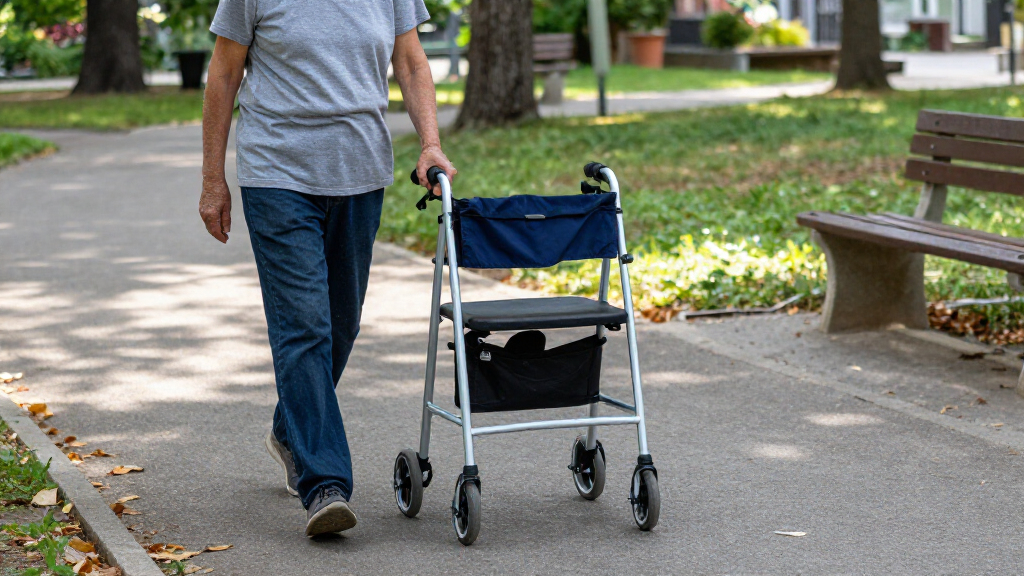
I ranked these folding walkers by how well their listed design features address everyday senior mobility needs: a manageable fold, usable frame dimensions, practical weight, and a stable setup for the intended walking surface. I gave extra attention to details that change daily handling, such as two-button versus paddle or trigger releases, narrow versus standard frames, and whether the walker uses fixed legs, wheels, or ski glides. Capacity and height adjustment also matter, but a listed capacity alone does not confirm personal fit or clinical suitability.
The order favors the most straightforward options for broad use, then recognizes models with a clearer advantage for tighter spaces, alternative folding controls, or rolling movement. Products with similar names are not treated as interchangeable; buyers should confirm the exact version and specifications. The lineup does not provide enough detail to rank every model on durability or comfort, so I avoid claims that would require hands-on testing. A physical therapist or clinician can help confirm fit and safe use, particularly when balance, grip strength, or a medical condition affects walker choice.
Factors to Consider When Choosing Folding Walkers For Seniors
A folding walker should fit both the person and the route they walk each day. Beyond comparing model names, I would check doorway clearance, folding effort, movement across the home’s surfaces, and whether the user can keep the walker close while stepping. These checks often matter more than an extra feature.
Match Walker Width to Real Routes
Measure the narrowest doorway and hallway the user needs to pass through, then compare that space with the walker’s outside width. A narrow frame, such as the Vive Mobility narrow model in this lineup, can help in confined rooms, but narrower is not automatically safer or more comfortable. The user needs room to stand within the frame and move their hands without striking the sides. Avoid measuring only the doorway: furniture, bathroom turns, and reaching a chair can make a route harder than a straight passage. If possible, check the manufacturer’s dimensions in both open and folded positions. A walker that clears a doorway but forces awkward steps around furniture may not be a good daily fit.
Choose a Folding Control the User Can Operate
Two-button, paddle, and trigger-release mechanisms all aim to make folding easier, but they call for different hand movements. Someone with limited finger strength or arthritis may find one style more manageable than another, while a caregiver may do most of the folding. Ask the user to try the release with the hand they can use comfortably, if a local supplier or clinician can arrange it. Do not assume that a quick-release label means the control is easy for every person to operate. Also check whether the walker can be folded without lifting it awkwardly or placing fingers near moving joints. The simplest mechanism for the user is usually more useful than a feature that looks convenient on paper.
Think About Wheels, Glides, and Floor Surfaces
Wheels can reduce the need to lift the front of a walker with each step, while rear ski glides are designed to slide along as the frame advances. That can make a wheeled or glide-equipped model easier to move on suitable indoor flooring, but it can also change how quickly the walker rolls. Fixed rubber tips tend to resist movement more, which some users prefer for controlled placement. Carpet pile, thresholds, outdoor paths, and wet surfaces can all affect how the walker behaves. A combination of 5-inch wheels and ski glides is not a guarantee of safe use on every surface. Match the setup to the actual route, and ask a clinician to check technique if the user is unsure how to advance the frame safely.
Check Height, Hand Position, and Weight Capacity
A walker that is too tall or too short can make the user lean, shrug, or put weight through the arms in an uncomfortable way. Use the manufacturer’s height-adjustment range as a starting check, then confirm that the hand grips can be set for a relaxed stance with slightly bent elbows. Capacity is a separate limit: never infer it from a product’s appearance or from another model with a similar name. One listing in this group specifies a 350-pound capacity, but that figure should be checked against the exact product version and the user’s needs. A caregiver should also consider the walker’s own weight if it needs to be lifted into a vehicle or stored often. A clinician or mobility professional can help confirm both fit and safe weight-bearing use.
Plan for Storage and Transport Before Buying
Folding walkers vary in how compact they become and how much effort folding takes, so check folded dimensions rather than relying on the word “folding.” Think about where the walker will be stored, whether it must fit beside a car seat, and who will lift it. A lightweight frame can be easier for a caregiver to handle, but the user still needs a stable, correctly fitted walker when walking. Practice opening and locking the frame before relying on it outside the home. Keep fingers clear of hinges and confirm that the walker is fully open and secure according to its instructions. If travel is occasional, storage convenience may matter less than a comfortable fit for daily use.
Decide When Added Features Are Worth It
Pay more attention to features that solve a specific mobility problem than to a long list of adjustments. A narrow frame may earn its place in a small apartment, and a different folding release may help a person who struggles with standard buttons. Wheels and glides may be useful when lifting a conventional walker is difficult, provided they suit the user’s balance and surfaces. If none of those needs applies, a basic two-button model may be easier to understand and maintain. Before choosing a specialized design, check replacement tips or glide compatibility and follow the maker’s maintenance instructions. A physical therapist can help decide whether a feature supports the user’s gait rather than simply adding complexity.
Frequently Asked Questions
Should I choose a standard folding walker or one with front wheels?
The choice depends on whether the user can lift and place a standard walker comfortably with each step. Front wheels can reduce that lifting motion, but they also let the frame roll and may not suit someone who needs the added resistance of fixed legs. Rear ski glides can make a wheeled walker move along more smoothly on appropriate indoor surfaces, though they are not suited to every floor or outdoor route. Check the user’s balance and walking pattern with a clinician before changing from a fixed-leg design. The best setup is the one the user can control consistently on their regular route.
Is a narrow folding walker a good choice for a small home?
A narrow frame can make tight hallways and doorways easier to pass, but the outside width is only one part of fit. The user also needs space to stand inside the frame, place their hands naturally, and turn without bumping furniture. Measure doorways and the tightest turns, then compare the figures with the exact model’s dimensions. Do not select a narrower walker if it crowds the user’s stance or restricts comfortable arm placement. If the home has several tight passages, a clinician or mobility supplier can help check maneuverability before purchase.
Which folding mechanism is easiest for someone with arthritis or weak hands?
There is no single release style that works best for everyone: two-button, paddle, and trigger mechanisms require different motions and grip strength. A person with finger stiffness may find it difficult to press small buttons, while a larger control may still require a firm squeeze or reach. If possible, have the user try the exact mechanism rather than choosing from its name alone. A caregiver’s ability to fold the walker is useful, but the user should not be left with a frame they cannot safely manage when alone. Ask an occupational therapist or mobility professional to assess hand function if the release remains difficult.
How do I confirm that a folding walker will fit the user?
Start with the manufacturer’s height range, frame width, and stated weight capacity for the exact model. A suitable height should let the user stand upright with hands on the grips and elbows slightly bent, rather than forcing a forward lean or raised shoulders. Check that the frame provides enough room for a comfortable stance and that its width fits the user’s routes. Do not rely on a listing’s capacity or adjustment range as proof that the walker is clinically appropriate. A clinician can check fit and walking technique, especially if the user has balance problems or needs to bear substantial weight through the arms.
Can I use a walker with wheels and ski glides outside?
That depends on the specific walker, its instructions, and the outdoor surface. Wheels and glides may move differently on uneven pavement, gravel, grass, slopes, or wet ground than they do on smooth indoor flooring. A setup that feels manageable inside may slide or catch outside, so do not assume the same level of control across surfaces. Check the manufacturer’s guidance and have the user practice only in a safe, supervised setting if outdoor use is permitted. For frequent outdoor walking, ask a clinician whether this walker style matches the user’s balance and route.
Conclusion
For a general-purpose starting point, I would choose the Drive Medical 2-Button Standard Foldable Walker as best overall for shoppers seeking a conventional design. The best value direction is a basic two-button model such as the Drive or a Medline lightweight option, provided its exact fit and features match the user; I would not choose by price alone. For beginners, a standard frame with a familiar, uncomplicated release is easier to learn than a specialized setup. The Vive Mobility Narrow Frame Walker is the best match for tight indoor routes, while the Medline Folding Paddle Walker is worth comparing when a different folding control may suit the user. For buyers seeking a premium-style feature set, focus on the specific benefit needed—such as a trigger release, wheels, or ski glides—rather than assuming added mechanisms are inherently better. Confirm dimensions, capacity, and safe use with a clinician or mobility professional before settling on a model.