
For seniors seeking a balance of support, everyday usability, and connected features, I name the Jabra Enhance Select M3 Aureon my best overall pick, with ELEHEAR Beyond Pro models standing out for Bluetooth and speech-focused features. Compact in-ear options such as Audien Atom X may suit buyers who value a discreet fit, while behind-the-ear designs can be easier to handle and adjust. The main tradeoffs are simplicity versus customization, discreet size versus ease of handling, and rechargeable convenience versus the need to manage charging. Features and fit vary across this lineup, so the best choice depends on hearing needs, dexterity, and preferred controls. Continue reading for the full breakdown and a guide to matching an option to your routine.

Turn quiet afternoons into listening time
- Thousands of audiobooks, podcasts and originals
- Listen on your phone, tablet or Echo — also offline
- Cancel anytime
Complete the kit

Key Takeaways
- Jabra Enhance Select M3 Aureon ranks first because it offers the strongest all-around balance in this comparison; buyers who prioritize a particular fit or feature may prefer a more specialized option.
- ELEHEAR Beyond Pro models are the connectivity-focused standouts, while the Beyond and Beyond 2 Pro highlight speech-oriented processing. Compare their exact versions rather than assuming similarly named products have identical features.
- Behind-the-ear designs trade discretion for handling room; Karthus R11 and the noise-reduction BTE option may be easier for some seniors to grip than small in-ear devices.
- Audien Atom X stands apart through its touchscreen charging case, which may help with controls but adds a case interface that buyers should be comfortable operating.
- This lineup mixes hearing aids and hearing amplifiers. Nvdskn M2219 is described as an amplifier, so shoppers should check product classification and suitability rather than treating every listing as equivalent hearing support.
| Jabra Enhance Select M3 Aureon Rechargeable Hearing Aids, Sand |  | Best for Audiology Support | Style: Rechargeable receiver-in-ear | Weight: 2.12 grams per hearing aid | Battery life: Over 24 hours per charge | VIEW LATEST PRICE | See Our Full Breakdown |
| ELEHEAR Beyond Pro Bluetooth Hearing Aids for Seniors |  | Best for App Features | Type: Over-the-counter receiver-in-canal hearing aids | Connectivity: Bluetooth; iOS and Android app | Sound processing: VocClear 2.0; speech detail up to 8500 Hz; 8 ms latency | VIEW LATEST PRICE | See Our Full Breakdown |
| Nvdskn M2219 Rechargeable In-Ear Hearing Amplifiers with Noise Cancellation | 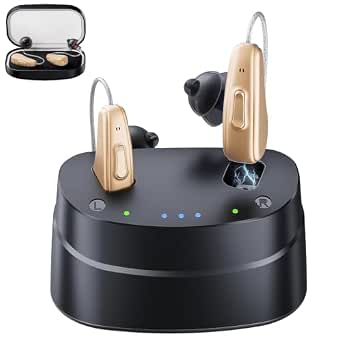 | Best for Long Case Runtime | Fit type: In-ear | Controls: Button controls with 5 volume levels and last-setting memory | Volume gain: 43 dB ± 5 dB | VIEW LATEST PRICE | See Our Full Breakdown |
| Karthus Rechargeable Hearing Aids for Seniors, Ice Silver |  | Best for App-Free Controls | Design: Behind-the-ear RIC | Weight: 0.1 oz | Processing: 16-channel DSP | VIEW LATEST PRICE | See Our Full Breakdown |
| Karthus R11 Rechargeable Behind-the-Ear Hearing Aids |  | Best Simple Behind-the-Ear Pick | Fit type: Behind-the-ear | Hearing modes: Quiet Mode and Noise Mode | Volume levels: 7 | VIEW LATEST PRICE | See Our Full Breakdown |
| Vivtone Xpure 3.0 Bluetooth OTC Hearing Aids for Seniors |  | Best for Smartphone Streaming | Design: Receiver-in-Canal (RIC) | Connectivity: Bluetooth | Compatibility: iOS 13 or later; Android 10 or later | VIEW LATEST PRICE | See Our Full Breakdown |
| Audien Atom X OTC Hearing Aids with Touchscreen Charging Case |  | Best for App-Free Controls | Fit: In-ear | Control: Touchscreen charging case | Listening modes: 4: Conversation, Crowd, TV, Comfort | VIEW LATEST PRICE | See Our Full Breakdown |
| Rechargeable Hearing Aids for Seniors and Adults with 5-Level Volume Control |  | Best for Long Battery Life | Technology: Receiver-in-Canal (RIC) | Noise reduction: 16-channel chip with intelligent noise-canceling technology | Volume control: 5 levels with volume memory | VIEW LATEST PRICE | See Our Full Breakdown |
| ELEHEAR Beyond OTC Rechargeable Hearing Aids with AI Speech Enhancement |  | Best for App-Based Speech Tuning | Design: Rechargeable receiver-in-the-canal | Hearing loss range: Mild to moderate | Maximum gain: Up to 50 dB | VIEW LATEST PRICE | See Our Full Breakdown |
| ELEHEAR Beyond 2 Pro OTC Hearing Aids for Seniors, 39% Clearer Speech |  | Best for Durability and Broadcast Streaming | Fit type: Behind-the-ear | Speech technology: VocClear 3.0 speech enhancement and feedback suppression | Bluetooth: Version 5.3; supports music, calls, and Auracast broadcast audio | VIEW LATEST PRICE | See Our Full Breakdown |
| ELEHEAR Beyond Pro OTC Bluetooth Rechargeable Hearing Aids |  | Best for App-Based Fine-Tuning | Fit: Behind-the-ear receiver-in-canal | Intended hearing loss: Mild to moderate | Amplification: 50 dB | VIEW LATEST PRICE | See Our Full Breakdown |
| Karthus Rechargeable OTC Hearing Aids for Seniors |  | Best for App-Free Simplicity | Fit: Behind-the-ear | Intended hearing loss: Mild to moderate | Sound processing: 16-channel DSP | VIEW LATEST PRICE | See Our Full Breakdown |
| Rechargeable Behind-the-Ear Hearing Aids with Noise Reduction |  | Best for Simple, Memory-Based Controls | Fit: Behind-the-ear | Sound processing: 16-channel chip with noise reduction | Volume levels: Five: 24, 28, 32, 36, and 40 dB | VIEW LATEST PRICE | See Our Full Breakdown |
| Audien Atom One OTC Hearing Aids |  | Best for In-Ear Wear and Guided Setup | Fit: In-ear | Intended users: Seniors and adults with mild to moderate hearing loss | Controls: Analog volume and frequency dials | VIEW LATEST PRICE | See Our Full Breakdown |
| Oricle Standard 2.0 Rechargeable In-Ear Hearing Aids with Noise Reduction and Charging Case |  | Best for Extended Use Between Charges | Model: Standard 2.0; HA-JHA490-2.0 | Fit: In-ear | Material: Silicone | VIEW LATEST PRICE | See Our Full Breakdown |
| hearing aids for senior | Battery life |
|---|---|
| Jabra Enhance Select M3 Aureon | Over 24 hours per charge |
| ELEHEAR Beyond Pro Bluetooth H | Up to 20 hours per charge |
| Nvdskn M2219 Rechargeable In-E | — |
| Karthus Rechargeable Hearing A | Up to 30 hours per charge; up to 100 hours with charging case |
| Karthus R11 Rechargeable Behin | Up to 30 hours per charge; up to 100 hours with charging case |
| Vivtone Xpure 3.0 Bluetooth OT | Over 18 hours of hearing-aid use; up to 3 hours of Bluetooth streaming |
| Audien Atom X OTC Hearing Aids | Up to 16 hours per charge; up to 48 hours with charging case |
| Rechargeable Hearing Aids for | Up to 25 hours per charge; up to 100 hours with charging case |
| ELEHEAR Beyond OTC Rechargeabl | Up to 20 hours per charge; up to 100 hours with the charging case |
| ELEHEAR Beyond 2 Pro OTC Heari | Up to 20 hours per charge |
| ELEHEAR Beyond Pro OTC Bluetoo | Up to 20 hours per charge |
| Karthus Rechargeable OTC Heari | Up to 30 hours per charge; up to 100 hours with charging case |
| Rechargeable Behind-the-Ear He | Up to 25 hours per charge; 80–100 hours with charging case |
| Audien Atom One OTC Hearing Ai | Up to 24 hours |
| Oricle Standard 2.0 Rechargeab | Up to 60 hours per charge |
More Details on Our Top Picks
Jabra Enhance Select M3 Aureon Rechargeable Hearing Aids, Sand
For seniors who want rechargeable hearing aids plus access to professional guidance, the Jabra Enhance Select M3 Aureon is the most support-focused choice in this group. Its adaptive listening features adjust speech emphasis and noise reduction as surroundings change, while licensed professionals can provide programming and remote adjustments. That support sets it apart from the more self-directed ELEHEAR Beyond Pro, whose app offers sound controls and specialist adjustments but also emphasizes soundscapes and translation. Jabra adds hands-free calls, Bluetooth streaming, IP68 protection, and a stated battery life of more than 24 hours per charge. The tradeoff is that some advanced programming depends on professional help, and newer Bluetooth LE Audio and Auracast functions require compatible devices. Choose it for ongoing care, not for the simplest or least-connected setup.
Pros:- Adaptive listening adjusts speech clarity and noise reduction to the environment.
- More than 24 hours of stated listening per charge.
- Licensed professional programming, unlimited appointments, and remote adjustments are included.
- Supports Bluetooth streaming, hands-free calls, and IP68 water and dust resistance.
Cons:- Some advanced programming requires assistance from a licensed hearing professional.
- Bluetooth LE Audio and Auracast features require compatible devices.
Best for: Seniors who want rechargeable RIC hearing aids with regular access to licensed professionals for programming and remote adjustments.
Not ideal for: Buyers who want fully self-guided adjustments or plan to use Bluetooth LE Audio and Auracast without checking device compatibility.
- Style:Rechargeable receiver-in-ear
- Weight:2.12 grams per hearing aid
- Battery life:Over 24 hours per charge
- Water and dust resistance:IP68
- Connectivity:Bluetooth LE Audio and Auracast; compatible Apple and Android devices
- Controls:App controls and double-tap call answering
- Audiology services:Licensed professional programming, unlimited appointments, and remote adjustments 7 days a week
- Warranty and protection:3-year warranty and 3-year loss and damage protection
Our verdict“Choose the Jabra if professional programming and ongoing remote support matter more than having the simplest, app-free controls.”
ELEHEAR Beyond Pro Bluetooth Hearing Aids for Seniors
The ELEHEAR Beyond Pro suits seniors who want more control over sound through a smartphone, including 20 soundscapes, a music mode, and remote adjustments from hearing care specialists. Its VocClear 2.0 processing is designed to bring speech detail forward, making it a more app-centered pick than the Karthus R11, which skips Bluetooth and wireless functions for simpler physical controls. A quick-charge feature is useful when the aids run low: 15 minutes is stated to provide up to six hours of use, and the case holds four additional charges. The listed runtime is up to 20 hours per charge, shorter than the Jabra’s stated runtime of over 24 hours. Translation support in 20 languages may appeal to multilingual households, but app tools and translation depend on a compatible smartphone, and fit can vary by ear.
Pros:- Offers 20 soundscapes, a music mode, and Bluetooth app controls.
- A 15-minute quick charge is stated to provide up to six hours of use.
- Charging case provides four additional charges.
- Includes multiple dome sizes and remote sound adjustments from hearing care specialists.
Cons:- App controls and real-time translation depend on a compatible smartphone.
- Up to 20 hours per charge is less than the stated runtime of the Jabra Enhance Select M3 Aureon.
- Fit and comfort may vary between users.
Best for: Seniors comfortable using an iOS or Android phone who want adjustable sound profiles, specialist remote adjustments, and translation support.
Not ideal for: Buyers who prefer physical controls without a smartphone, or who want the longer per-charge runtime stated for the Karthus R11.
- Type:Over-the-counter receiver-in-canal hearing aids
- Connectivity:Bluetooth; iOS and Android app
- Sound processing:VocClear 2.0; speech detail up to 8500 Hz; 8 ms latency
- Soundscapes:20
- Battery life:Up to 20 hours per charge
- Quick charge:15 minutes for up to 6 hours of use
- Charging case:Provides 4 additional charges
- Translation:Real-time support for 20 languages
- Fit:Multiple dome sizes included
Our verdict“Pick the Beyond Pro if you want smartphone-based sound options and quick charging, and are comfortable relying on an app for its added features.”
Nvdskn M2219 Rechargeable In-Ear Hearing Amplifiers with Noise Cancellation
The Nvdskn M2219 is a straightforward choice for buyers who prioritize long stated listening time and button controls over smartphone features or professional programming. Five volume levels and memory for the last setting reduce the need to reset the aids each time they are used. Its case is rated for up to 100 hours of total listening time, giving it a different advantage from the Karthus R11: both offer long case-backed runtime, but the Nvdskn uses an in-ear fit and lists five volume levels, while the Karthus provides seven levels in a behind-the-ear design. The M2219 also includes three ear tip sizes. Its stated 43 dB ± 5 dB gain and moderate-hearing-loss positioning may not suit every hearing profile, and charging takes three hours. It is an amplifier, not a feature-rich connected option like the Jabra or ELEHEAR.
Pros:- Five button-controlled volume levels with memory for the last setting.
- Up to 25 hours of listening per charge.
- Charging case provides up to 100 hours of total listening time.
- Three ear tip sizes are included to help accommodate different fits.
Cons:- Three-hour charging time is longer than the quick-charge options listed for the ELEHEAR Beyond Pro and Karthus R11.
- Designed for moderate hearing loss and may not suit all users.
- No app, Bluetooth, or professional adjustment service is specified.
Best for: Seniors seeking a rechargeable in-ear amplifier with physical volume buttons, setting memory, and extended listening time between case recharges.
Not ideal for: Buyers who need Bluetooth or app controls, professional audiology support, or help for hearing loss beyond the stated moderate range.
- Fit type:In-ear
- Controls:Button controls with 5 volume levels and last-setting memory
- Volume gain:43 dB ± 5 dB
- Listening time per charge:Up to 25 hours
- Total listening time with charging case:Up to 100 hours
- Charging time:3 hours
- Noise control:Active noise cancellation
- Ear tip sizes:3
- Color:Beige
Our verdict“Choose the M2219 if you want basic button controls and long case-backed runtime, rather than connected features or a behind-the-ear fit.”
Karthus Rechargeable Hearing Aids for Seniors, Ice Silver
For seniors who would rather press a button than manage hearing aids through a phone, the Karthus Rechargeable Hearing Aids keep operation simple: physical controls, seven volume levels, and two modes for quieter or noisier settings. That makes them less dependent on setup than the ELEHEAR Beyond Pro, whose soundscapes and adjustments rely on an app. Karthus also lists up to 30 hours per charge and up to 100 hours with the case, plus a 15-minute quick charge for up to six hours of use. Its lightweight behind-the-ear RIC design and soft tulip tips may appeal to people who find in-ear amplifiers uncomfortable, though fit still varies. The tradeoff is a lack of app or Bluetooth features, and this model is intended for mild to moderate hearing loss rather than more severe needs.
Pros:- Physical controls work without an app or smartphone.
- Quiet Mode and Noise Mode offer a simple way to respond to different settings.
- Up to 30 hours per charge and up to 100 hours with the charging case.
- Lightweight 0.1 oz design with soft tulip tips.
Cons:- No app or Bluetooth features are specified.
- Intended for mild to moderate hearing loss, not severe or profound loss.
- Fit and listening results may vary by person and environment.
Best for: Seniors with mild to moderate hearing loss who want rechargeable behind-the-ear aids with physical controls and no smartphone setup.
Not ideal for: Buyers who want Bluetooth streaming, app-based personalization, or support for severe or profound hearing loss.
- Design:Behind-the-ear RIC
- Weight:0.1 oz
- Processing:16-channel DSP
- Volume levels:7
- Listening modes:Quiet Mode and Noise Mode
- Battery life:Up to 30 hours per charge; up to 100 hours with charging case
- Quick charge:15 minutes provides up to 6 hours of use
- Controls:Physical switch and one-button controls
- Intended hearing loss:Mild to moderate
Our verdict“Choose this Karthus model if you value physical, app-free controls and long stated battery life over wireless features.”
Karthus R11 Rechargeable Behind-the-Ear Hearing Aids
The Karthus R11 makes sense for seniors who want a familiar behind-the-ear shape and straightforward controls without app setup. Its one-button controls adjust among seven volume levels, while Quiet Mode and Noise Mode offer a basic way to adapt between calmer rooms and busier surroundings. Like the other Karthus model here, it lists up to 30 hours per charge and up to 100 hours with its case; the Nvdskn M2219 offers a similar total case runtime but uses an in-ear fit and five volume levels instead. The R11’s 16-channel processing is intended to help clarify speech and reduce background noise, but no Bluetooth, app, or wireless function is included. It is also specified for mild to moderate hearing loss, so buyers needing more individualized professional programming may prefer the Jabra.
Pros:- One-button operation with seven volume levels.
- Quiet Mode and Noise Mode provide two listening options.
- Up to 30 hours per charge and up to 100 hours with the charging case.
- Behind-the-ear fit avoids an entirely in-ear design.
Cons:- No app, Bluetooth, or wireless function.
- Intended for mild to moderate hearing loss.
- Provides two listed listening modes rather than the app-based sound options available on the ELEHEAR Beyond Pro.
Best for: Seniors with mild to moderate hearing loss who want a rechargeable behind-the-ear design, physical controls, and long stated runtime without app features.
Not ideal for: Buyers who want Bluetooth streaming, wireless adjustments, smartphone controls, or professional programming like the Jabra Enhance Select M3 Aureon.
- Fit type:Behind-the-ear
- Hearing modes:Quiet Mode and Noise Mode
- Volume levels:7
- Battery life:Up to 30 hours per charge; up to 100 hours with charging case
- Charging:Rechargeable; 15-minute quick charge
- Battery type and voltage:Lithium-ion; 3.7 volts
- Weight:6.8 g
- Controls:One-button control
- Connectivity:No app, Bluetooth, or wireless function
Our verdict“Pick the R11 if you want a simple rechargeable behind-the-ear aid with physical controls and do not need wireless features.”
Vivtone Xpure 3.0 Bluetooth OTC Hearing Aids for Seniors
For seniors who want hearing support and everyday phone audio in one device, the Vivtone Xpure 3.0 stands out for Bluetooth calls and streaming. Its app adds a hearing check, adjustable frequency and gain settings, and presets for situations such as restaurants, TV, and outdoor listening. That makes it more customizable than the Rechargeable Hearing Aids for Seniors and Adults with 5-Level Volume Control, which focuses on simple onboard volume adjustment and longer stated battery life.
The tradeoff is that Vivtone depends on a compatible smartphone: the listed requirements are iOS 13 or later or Android 10 or later. A full charge provides over 18 hours of hearing-aid use, but Bluetooth streaming is limited to up to three hours. I’d favor it for users who expect to stream occasionally, not for people who need long stretches of audio playback.
Pros:- Bluetooth supports phone calls, music, and other audio streaming.
- The app offers a hearing check and adjustable frequency and gain settings.
- Listening presets cover conversations, TV, meetings, restaurants, and outdoor settings.
- The case provides up to two additional recharges away from an outlet.
Cons:- Smartphone features require iOS 13 or later or Android 10 or later.
- Bluetooth streaming is limited to up to three hours per full charge.
- The charging time is approximately 2.5 hours.
Best for: Seniors with a compatible iPhone or Android phone who want app-based tuning and occasional calls or audio streaming through their hearing aids.
Not ideal for: People without a compatible smartphone, or users who expect to stream audio for much of the day on one charge.
- Design:Receiver-in-Canal (RIC)
- Connectivity:Bluetooth
- Compatibility:iOS 13 or later; Android 10 or later
- Listening modes:Presets for conversations, TV, meetings, restaurants, and outdoor settings
- Battery life:Over 18 hours of hearing-aid use; up to 3 hours of Bluetooth streaming
- Charging case:Up to two additional recharges
- Charging time:Approximately 2.5 hours
- Support:U.S.-based phone and after-sales support
Our verdict“Choose the Vivtone Xpure 3.0 if you want app-tuned hearing support with occasional Bluetooth streaming and have a compatible smartphone.”
Audien Atom X OTC Hearing Aids with Touchscreen Charging Case
The Audien Atom X is a strong fit for seniors who would rather adjust hearing aids at the case than manage settings through a phone. Its touchscreen charging case controls volume and four listening modes, while the included expert-guided setup and fitting accessories offer more onboarding help than the Rechargeable Hearing Aids for Seniors and Adults with 5-Level Volume Control. The modes cover conversation, crowds, TV, and quieter moments, giving users a direct way to change the sound profile as their setting changes.
That simplicity comes with limits: the listed controls are centered on the case, and a charge provides up to 16 hours, shorter than the 20-hour claim for the ELEHEAR Beyond OTC Rechargeable Hearing Aids with AI Speech Enhancement. Comfort also depends on finding a suitable ear-dome fit. I’d choose Atom X for hands-on, app-free adjustments, not for buyers prioritizing a longer per-charge run time.
Pros:- Touchscreen case controls volume and modes without a smartphone app.
- Four listening modes cover conversation, crowds, TV, and comfort.
- Expert-guided setup and fitting and care accessories are included.
- The case provides portable backup charging.
Cons:- Up to 16 hours per charge may require daily recharging.
- Comfort depends on selecting an ear dome that fits well.
- In-ear design may not suit seniors who prefer a behind-the-ear fit.
Best for: Seniors who want to change volume and listening modes without a smartphone app and appreciate guided setup and included fitting accessories.
Not ideal for: People who need more than 16 hours of use between charges or have difficulty finding a comfortable in-ear dome fit.
- Fit:In-ear
- Control:Touchscreen charging case
- Listening modes:4: Conversation, Crowd, TV, Comfort
- Battery life:Up to 16 hours per charge; up to 48 hours with charging case
- Power source:Rechargeable lithium-ion batteries
- Noise control:Active noise cancellation
- Included accessories:Touchscreen charging case, USB cable, wall adapter, extra ear domes, replacement wax guards, cleaning brush
- Material and color:Silicone; beige
Our verdict“Pick the Audien Atom X if app-free case controls and guided fitting matter more to you than extended use between charges.”
Rechargeable Hearing Aids for Seniors and Adults with 5-Level Volume Control
If charging frequency is a major concern, this RIC model leads the options here with up to 25 hours per charge and up to 100 hours using its case. Five volume levels, volume memory, and four silicone tips make it a straightforward choice for seniors who want to set a preferred level and keep it between uses. Compared with the Audien Atom X, it offers a longer stated run time per charge, while Audien adds a touchscreen case and guided setup.
The tradeoff is a simpler feature set: the product data lists no app connectivity or water-resistance rating, and the controls focus on volume rather than multiple environment-specific presets. Its 16-channel noise-reduction chip and stated amplification may suit some users, but the provided information does not describe personalized fitting. I’d choose it for battery endurance and uncomplicated adjustment, not for smartphone tuning or advanced connectivity.
Pros:- Up to 25 hours of use per charge and up to 100 hours with the charging case.
- Five volume levels and volume memory help retain a preferred setting.
- Four silicone ear tips provide several fit options.
- A 16-channel chip is designed to reduce noise and echoes.
Cons:- The product data does not specify app connectivity or Bluetooth streaming.
- No water-resistance rating is provided.
- The listed controls emphasize volume rather than selectable listening modes.
Best for: Seniors who want long intervals between charges, simple volume adjustment, and several ear-tip sizes for fitting.
Not ideal for: Buyers who want app-based customization, Bluetooth streaming, or a stated water-resistance rating.
- Technology:Receiver-in-Canal (RIC)
- Noise reduction:16-channel chip with intelligent noise-canceling technology
- Volume control:5 levels with volume memory
- Sound amplification:Up to 40 dB ± 5 dB
- Battery life:Up to 25 hours per charge; up to 100 hours with charging case
- Charging case:Provides 3 to 4 full charges
- Ear tips:4 silicone tips: 1 small, 2 medium, 1 large
- Battery display:LED display
Our verdict“Choose this model if long battery life and simple volume memory matter more than app features or streaming.”
ELEHEAR Beyond OTC Rechargeable Hearing Aids with AI Speech Enhancement
The ELEHEAR Beyond is aimed at seniors with mild to moderate hearing loss who want speech-focused processing and room to personalize settings. Its VocClear AI speech enhancement, noise attenuation, and feedback control are intended to make conversation clearer without relying on volume alone. The iOS and Android app adds customization, setting it apart from the Rechargeable Hearing Aids for Seniors and Adults with 5-Level Volume Control, which offers volume memory and longer stated use per charge but no listed app connection.
Battery life is a strength: the aids provide up to 20 hours per charge, with up to 100 hours using the case. The compromise is that app-dependent features require a compatible phone, and the stated hearing-loss range may not suit people with severe loss. Compared with the ELEHEAR Beyond 2 Pro, this model’s supplied details emphasize AI speech processing and case capacity, while the Pro adds an IP67 rating and Auracast support.
Pros:- VocClear AI, noise attenuation, and feedback control target speech clarity.
- The companion app works with iOS and Android for customizable settings.
- Up to 20 hours per charge and up to 100 hours with the case.
- Automatic power on and off when removed from or placed in the case.
Cons:- The stated fit is for mild to moderate hearing loss, not severe loss.
- Some customization features depend on the companion app.
- The product data does not specify a water-resistance rating.
Best for: Seniors with mild to moderate hearing loss who want app customization and speech-focused processing for everyday conversations.
Not ideal for: People with severe hearing loss or those who do not want to use a smartphone app for customization.
- Design:Rechargeable receiver-in-the-canal
- Hearing loss range:Mild to moderate
- Maximum gain:Up to 50 dB
- Noise attenuation:24 dB
- Connectivity:Bluetooth
- App compatibility:iOS and Android
- Battery life:Up to 20 hours per charge; up to 100 hours with the charging case
- Charging case:Provides 4 additional charging cycles
Our verdict“Choose the ELEHEAR Beyond if you have mild to moderate hearing loss and want app-tuned speech enhancement with substantial case backup.”
ELEHEAR Beyond 2 Pro OTC Hearing Aids for Seniors, 39% Clearer Speech
The Beyond 2 Pro makes the most sense for seniors who want a behind-the-ear design with more protection and modern audio connections. Its IP67 rating addresses dust, sweat, and light rain, while Bluetooth 5.3 supports calls, music, and Auracast broadcast audio. That makes it a different proposition from the ELEHEAR Beyond OTC Rechargeable Hearing Aids with AI Speech Enhancement: both offer app customization and up to 20 hours per charge, but this Pro model adds the published durability rating and broadcast support.
VocClear 3.0 is designed to enhance speech and suppress feedback, and the slim behind-the-ear fit may appeal to people who prefer not to place the main aid in the ear. The tradeoff is app reliance for full functionality and customization; the supplied data does not describe app-free tuning. I’d choose it for protection and connectivity, rather than for someone seeking the simplest controls.
Pros:- IP67 rating provides resistance to dust, sweat, and light rain.
- Bluetooth 5.3 supports calls, music, and Auracast broadcast audio.
- VocClear 3.0 is designed to enhance speech and suppress feedback.
- Up to 20 hours of use per charge with approximately 1.5-hour charging.
Cons:- Full functionality and customization require the ELEHEAR app.
- The behind-the-ear style may not suit buyers seeking an in-ear design.
- The stated battery life is up to 20 hours per charge, rather than longer between-charge use.
Best for: Seniors who prefer a behind-the-ear fit and want Bluetooth streaming, Auracast support, and resistance to dust, sweat, and light rain.
Not ideal for: People who want full controls without a smartphone app or who prefer a small in-ear hearing aid.
- Fit type:Behind-the-ear
- Speech technology:VocClear 3.0 speech enhancement and feedback suppression
- Bluetooth:Version 5.3; supports music, calls, and Auracast broadcast audio
- Battery life:Up to 20 hours per charge
- Charging time:Approximately 1.5 hours
- Charging case:Provides 4 additional charges
- Water and dust resistance:IP67
- Weight per aid:4.3 g
- Color:Silver Gray
Our verdict“Choose the Beyond 2 Pro if you want a protected behind-the-ear design with Auracast and app-based customization.”
ELEHEAR Beyond Pro OTC Bluetooth Rechargeable Hearing Aids
For seniors who want to adjust sound from a phone rather than rely on fixed presets, the ELEHEAR Beyond Pro is the most configurable pick here. Its app offers 20 soundscapes, while noise cancellation and feedback reduction can help make everyday listening less distracting. Bluetooth 5.3 also supports connections to compatible devices, giving it more flexibility than the button-only Karthus Rechargeable OTC Hearing Aids, which skip Bluetooth and apps altogether. Battery life is practical for a day, and a short charge can help when the aids run low. The tradeoff is that its extra controls depend on a compatible smartphone or tablet, and its stated use is limited to mild to moderate hearing loss. Choose it for personalized adjustments, not for app-free simplicity or more severe loss.
Pros:- App offers sound adjustments and 20 soundscapes for tailoring listening to different situations.
- Bluetooth 5.3 supports connections to compatible smartphones, tablets, and music players.
- Up to 20 hours per charge, with a 15-minute charge providing up to six hours of use.
- Noise cancellation, feedback reduction, multiple dome sizes, and remote specialist support are included.
Cons:- App controls require a compatible smartphone or tablet.
- Designed for mild to moderate hearing loss, not severe or profound loss.
Best for: Seniors with mild to moderate hearing loss who use a compatible smartphone and want adjustable sound profiles and Bluetooth connectivity.
Not ideal for: People who prefer physical controls without a phone, or anyone seeking support for severe or profound hearing loss.
- Fit:Behind-the-ear receiver-in-canal
- Intended hearing loss:Mild to moderate
- Amplification:50 dB
- Bluetooth:5.3
- Battery life:Up to 20 hours per charge
- Fast charging:15 minutes provides up to 6 hours of use
- Charging case:Four additional charges
- App compatibility:iOS and Android
Our verdict“Choose the ELEHEAR Beyond Pro if you want Bluetooth and app-based sound adjustments; pick the Karthus instead if you want straightforward button controls without a phone.”
Karthus Rechargeable OTC Hearing Aids for Seniors
The Karthus is a strong fit for seniors who want to make changes on the hearing aids themselves, without pairing a phone or learning an app. Seven button-controlled volume levels and two listening modes offer more direct control than the Audien Atom One, whose sound adjustments use analog dials. Its stated battery life—up to 30 hours per charge and up to 100 hours with the case—also suits people who would rather charge less often. Quiet Mode and Noise Mode give users a simple way to adapt between calmer rooms and noisier settings, though they are less customizable than the ELEHEAR Beyond Pro’s app soundscapes. Karthus remains an OTC option for mild to moderate hearing loss; fit and results can vary, so its long runtime should not be mistaken for a substitute for a professional hearing assessment.
Pros:- Button controls provide seven volume levels without an app, Bluetooth, or pairing.
- Quiet Mode and Noise Mode provide simple choices for different listening environments.
- Up to 30 hours per charge and up to 100 hours with the charging case.
- A 15-minute quick charge provides up to six hours of use.
Cons:- No app, Bluetooth, or pairing options for streaming or remote sound adjustments.
- Intended for mild to moderate hearing loss, and listening results can vary with fit and surroundings.
Best for: Seniors with mild to moderate hearing loss who want physical volume buttons, basic environment modes, and long battery life without smartphone setup.
Not ideal for: People who want Bluetooth streaming, app-based customization, or support intended for severe or profound hearing loss.
- Fit:Behind-the-ear
- Intended hearing loss:Mild to moderate
- Sound processing:16-channel DSP
- Listening modes:Quiet Mode and Noise Mode
- Volume control:Seven levels; button control
- Connectivity:No app, Bluetooth, or pairing required
- Battery life:Up to 30 hours per charge; up to 100 hours with charging case
- Quick charge:15 minutes provides up to 6 hours of use
Our verdict“Pick Karthus for phone-free controls and extended battery life, but choose the ELEHEAR Beyond Pro if Bluetooth and more detailed app adjustments matter more.”
Rechargeable Behind-the-Ear Hearing Aids with Noise Reduction
This nvdskn model keeps operation pared back: a single button selects among five volume levels, and volume memory retains the previous setting. That makes it a more basic alternative to the Karthus, which has seven levels and two named listening modes, but may appeal to someone who wants fewer choices to manage. Its 16-channel processing and noise reduction are intended to help voices stand out from background sound, while the behind-the-ear design is described as comfortable with glasses. The rechargeable battery is rated for up to 25 hours per charge, with additional use from its case. Unlike the ELEHEAR Beyond Pro, it has no Bluetooth or app controls; the listing also does not specify charging time or replacement-part availability. It suits buyers who prize straightforward operation over connected features.
Pros:- One-button operation and five volume levels keep adjustments straightforward.
- Volume memory retains the previous setting between uses.
- 16-channel processing and noise reduction are designed to help voices stand out from background sounds.
- Up to 25 hours of use per charge, with 80–100 hours stated with the charging case.
Cons:- No Bluetooth connectivity or app-based sound adjustments.
- Charging time and replacement-part availability are not specified in the provided product details.
Best for: Seniors who want a rechargeable behind-the-ear amplifier with a small set of physical controls and saved volume settings.
Not ideal for: Buyers who want Bluetooth streaming, app adjustments, clearly specified charging details, or more listening modes.
- Fit:Behind-the-ear
- Sound processing:16-channel chip with noise reduction
- Volume levels:Five: 24, 28, 32, 36, and 40 dB
- Controls:Button control with volume memory
- Battery:Rechargeable lithium-ion
- Battery life:Up to 25 hours per charge; 80–100 hours with charging case
- Color:Matte black
- Model:M2231
Our verdict“Choose this nvdskn model for simple, saved-setting operation, but choose Karthus if you want more volume steps and named listening modes.”
Audien Atom One OTC Hearing Aids
The Audien Atom One is the in-ear choice for seniors who prefer a less visible fit and want help getting started. Its analog volume and frequency dials avoid app setup, while the included expert-guided session offers support that the simpler Oricle Standard 2.0 listing does not specify. Three dome sizes give users a way to adjust fit, and the USB-C dock recharges the aids for up to 24 hours of use. The tradeoff is a more hands-on setup: buyers may need to adjust the dials and domes to find a comfortable sound, and this model has no noise-control feature. Compared with the behind-the-ear Karthus, Atom One trades longer stated runtimes and external controls for a compact in-ear style. It is intended for mild to moderate hearing loss, not every hearing need.
Pros:- In-ear fit offers an alternative to behind-the-ear styles.
- Analog volume and frequency dials work without app setup.
- Includes three dome sizes and an expert-guided setup session.
- Rechargeable battery provides up to 24 hours of use and charges through USB-C.
Cons:- No noise-control feature is specified.
- Fit and dial settings may take adjustment to suit the user.
- Charging takes about three hours.
Best for: Seniors with mild to moderate hearing loss who prefer in-ear aids, want physical sound controls, and value guided setup.
Not ideal for: People who need noise reduction, want Bluetooth or app controls, or prefer behind-the-ear devices that are easier to handle.
- Fit:In-ear
- Intended users:Seniors and adults with mild to moderate hearing loss
- Controls:Analog volume and frequency dials
- Battery life:Up to 24 hours
- Charging time:About 3 hours
- Charging connector:USB-C
- Included ear domes:Small, medium, and large
- Warranty:1 year
Our verdict“Choose Atom One if in-ear wear and guided setup are priorities; choose Oricle Standard 2.0 if noise reduction and saved settings matter more.”
Oricle Standard 2.0 Rechargeable In-Ear Hearing Aids with Noise Reduction and Charging Case
Oricle Standard 2.0 stands out for its stated up to 60 hours of use per charge, making it the battery-focused in-ear option in this group. Five sound levels, setting memory, and automatic on/off keep daily operation simple, while noise reduction may help in settings where background sound competes with conversation. Compared with the Audien Atom One, Oricle adds noise reduction and saved settings, but Audien provides more setup detail, including three dome sizes and expert-guided support. Oricle’s soft silicone tips are intended to provide a secure fit, though the product details do not specify a range of tip sizes or compatibility with prescription hearing aids. The in-ear design also means it will not suit everyone as well as a behind-the-ear option. Choose it for long stated runtime and basic controls, not connectivity or extensive fitting guidance.
Pros:- Up to 60 hours of use per charge is a long stated runtime for this lineup.
- Noise reduction is included to help with competing background sound.
- Five sound levels and setting memory make it easier to return to a familiar adjustment.
- Automatic on/off and a portable charging case support straightforward daily handling.
Cons:- The provided details do not specify compatibility with prescription hearing aids.
- No Bluetooth, app controls, or guided setup are listed.
- The in-ear fit may not suit seniors who prefer behind-the-ear devices.
Best for: Seniors who prefer an in-ear design and want noise reduction, saved sound settings, and less frequent charging.
Not ideal for: Buyers who need Bluetooth or app controls, detailed fitting support, or documented compatibility with prescription hearing aids.
- Model:Standard 2.0; HA-JHA490-2.0
- Fit:In-ear
- Material:Silicone
- Battery:Lithium-ion
- Battery life:Up to 60 hours per charge
- Controls:Button control with five sound levels
- Sound features:Noise reduction and setting memory
- Automatic operation:Automatic on/off
Our verdict“Choose Oricle for long stated runtime and saved settings in an in-ear design; choose Atom One if guided setup and multiple dome sizes are more useful.”

How We Picked
I compared the 15 listed products through the needs that most often shape a senior buyer’s decision: expected usability, handling and fit, control clarity, charging routine, connectivity, and the stated approach to speech or background-noise processing. I also paid attention to product type. An item described as a hearing amplifier is not automatically interchangeable with a hearing aid, so I treated that distinction as a meaningful buying factor rather than grouping every device together.
The ranking favors options with a broad mix of relevant features and a clear role, then separates more specialized choices by who may benefit from them. Jabra leads as the all-around recommendation; ELEHEAR models earn attention for Bluetooth and speech-focused features; discreet in-ear and behind-the-ear products serve different fit and handling priorities. Product names and feature claims do not establish a person’s hearing needs, so I also weigh practical tradeoffs and encourage buyers to check fit, support, and clinical guidance before choosing.
Factors to Consider When Choosing Best Hearing Aids For Seniors
Choosing hearing support is not just a matter of selecting the most feature-rich device. I would start with the wearer’s hearing needs and daily routine, then weigh fit, controls, charging, and how much adjustment they are prepared to manage.
Match the device to the hearing concern
Before buying, identify which situations are difficult: one-to-one conversation, television, group settings, or hearing alerts around the home. A device’s advertised speech or noise feature does not prove it will address a particular hearing pattern. Hearing aids and hearing amplifiers can differ in purpose, so check how the product is classified and what support accompanies it. If hearing has changed suddenly, differs greatly between ears, or comes with pain or dizziness, seek professional advice rather than relying on a consumer device alone. Matching the problem first helps prevent paying for features that do not solve the wearer’s main difficulty.
Choose a shape the wearer can handle
Small in-ear devices may be less visible, but their size can make insertion, removal, and cleaning harder for people with reduced dexterity or vision. Behind-the-ear designs are more exposed, yet their larger body may be easier to grip and adjust. Ask who will put the devices in each day and whether the wearer can distinguish left and right units. A comfortable fit matters as much as discretion; pressure or slipping can make a theoretically convenient device unpleasant to wear. If possible, check the return and fitting process before committing to a style.
Prioritize controls the wearer can operate
More adjustment options can help in changing environments, but they may also add steps that frustrate someone who wants a simple routine. Consider whether volume changes happen on the device, through an app, or via a case, and whether the wearer can see and understand those controls. Bluetooth can be useful for calls or streamed audio, but it may involve pairing and phone settings that some seniors would rather avoid. A family member can help with setup, yet day-to-day operation should suit the wearer. Choose the simplest control scheme that covers the situations they actually face.
Plan for charging and upkeep
Rechargeable devices remove the need for frequent battery changes, but they still require a dependable charging habit and a place to store the case. Think about whether the wearer remembers nightly routines and can connect cables or align the devices in a charging cradle. Cleaning, drying, and keeping ports clear also affect reliable use; a charging feature does not eliminate maintenance. Ask what replacement parts and service are available before purchase, especially if the device will be used every day. A simpler maintenance routine may matter more than a long list of audio features.
Treat claims and product labels carefully
Terms such as AI speech enhancement or noise reduction describe a product’s stated approach, not a guarantee that speech will be clear in every room. Ask what the feature is meant to improve and whether it can be adjusted or turned off if the sound feels unnatural. Compare the exact model name and included accessories, since similarly named versions may differ. Do not use a single promotional claim as a substitute for checking fitting guidance, service, and suitability for the wearer’s hearing. A realistic match is more useful than choosing the device with the boldest specification.
Know when paying more makes sense
Paying more can make sense when it buys support, a fitting process, connectivity the wearer will use, or controls that make daily operation easier. It is less useful when the added features are difficult to manage or address situations the wearer rarely encounters. Compare ongoing needs such as maintenance, replacement accessories, and help with setup—not just the device itself. A buyer who values discreet wear may prioritize a compact design, while someone with limited dexterity may benefit more from an easier-to-handle shape. Decide which benefit would change everyday use before choosing a higher-feature option.
Frequently Asked Questions
Should I choose a hearing aid or a hearing amplifier?
Start by checking how the product is described and what kind of support it is intended to provide. This roundup includes Nvdskn M2219, which is labeled a hearing amplifier, alongside products presented as hearing aids. The labels should not be treated as interchangeable, and amplification alone may not suit every hearing concern. If you are unsure what type of device fits the wearer’s needs, seek guidance from a hearing professional before purchasing. That step can help avoid choosing a product based on its name alone.
Are Bluetooth hearing aids worth choosing for a senior?
Bluetooth is useful when the wearer wants to connect to a phone or other compatible audio source and feels comfortable managing that connection. It can add setup steps, phone settings, and another task to troubleshoot, so it is not automatically a benefit for everyone. The ELEHEAR Beyond Pro options are the connectivity-focused choices in this lineup, but buyers should check the specific model’s capabilities and compatibility. If the wearer mainly wants straightforward amplification and rarely uses connected audio, a simpler control routine may be a better fit. Consider who will help with setup and ongoing pairing.
Is an in-ear or behind-the-ear design easier for older adults?
Neither style is easier for every senior. In-ear models may appeal to someone who wants a compact device, but their smaller size can be challenging to insert, remove, or clean. Behind-the-ear designs are more visible, yet some wearers find them easier to grip and adjust. Dexterity, eyesight, comfort, and whether someone can help with fitting should guide the decision. When possible, check the fit and return terms before settling on a style.
What should I check before buying a rechargeable hearing aid?
Check the charging method, what accessories are included, and how the wearer will fit charging into a daily routine. A rechargeable model can simplify battery management, but it still needs regular charging and basic cleaning. Make sure the case and controls are manageable for the person who will use them, particularly if vision or hand movement is limited. Also confirm how to get help if the device or charger stops working. These practical details can matter more than a feature the wearer may rarely use.
When should a senior get professional hearing advice instead of trying an OTC device?
Professional guidance is a sensible choice when the wearer is unsure about the cause or pattern of hearing difficulty, or when an over-the-counter device does not seem suitable. Sudden hearing changes, pain, dizziness, or a large difference between ears warrant prompt medical attention rather than trial-and-error shopping. A professional can help clarify what type of support may fit and whether another issue needs attention. OTC options may offer convenience, but a product description cannot diagnose hearing loss. The right next step depends on the symptoms and the wearer’s health history.
Conclusion
For the broadest mix of everyday features, I recommend Jabra Enhance Select M3 Aureon as best overall. Buyers seeking connected use and speech-focused options should compare the ELEHEAR Beyond Pro family, while those who want a compact design may prefer to explore Audien Atom X and confirm its case controls suit them. For a simpler start, I would choose the device with the clearest controls and most manageable fit rather than the one with the longest feature list; a behind-the-ear style may be a good place to begin for someone who finds tiny devices hard to handle. The lineup does not establish a single best-value or best-premium winner from verified service, warranty, or total ownership details, so I would compare those factors before paying more. For specific needs, prioritize the feature that addresses them—Bluetooth for connected audio, a manageable shape for dexterity, or professional advice when the hearing concern is uncertain.