TL;DR

Turn quiet afternoons into listening time
- Thousands of audiobooks, podcasts and originals
- Listen on your phone, tablet or Echo — also offline
- Cancel anytime
A report published by News-Medical on Oct. 16 describes SINTEF researcher Sandra Klonteig’s work on neurotechnology that measures brain activity and related signals. She says these methods could eventually help researchers detect treatment response and guide care for anxiety and depression, but the report does not present evidence that they are ready for routine clinical use.
SINTEF researcher Sandra Klonteig says brain-sensing technologies could eventually help clinicians better understand anxiety and depression and identify whether a treatment is working. A report published by News-Medical on Oct. 16 describes research into tools including eye-tracking and non-invasive measurements of brain activity, while emphasizing that the proposed clinical benefits remain a future possibility, not an established service for patients.
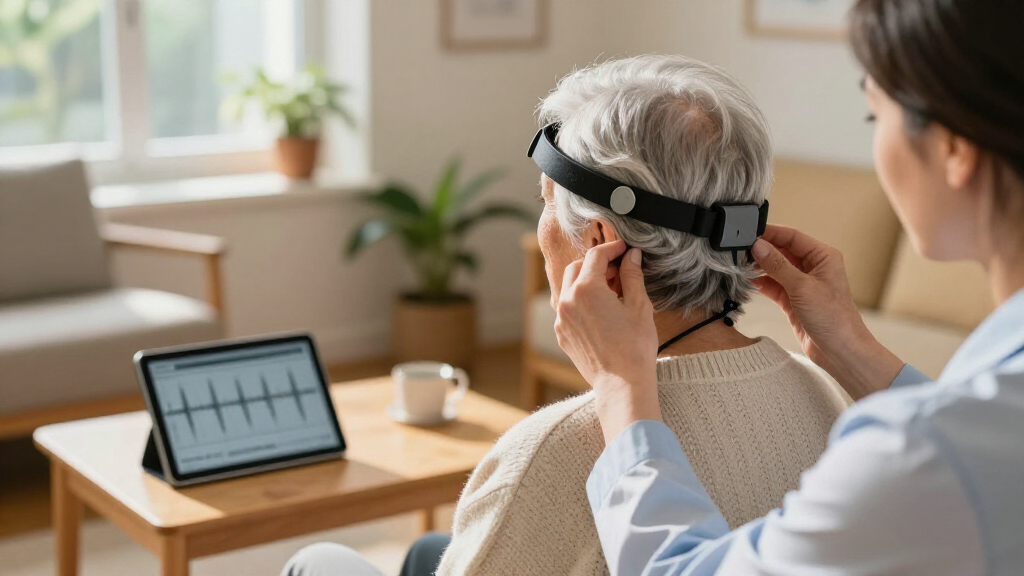
Klonteig, a research scientist at SINTEF Digital, studies the brain using sensors and neurotechnology. The report describes functional near-infrared spectroscopy, or fNIRS, which measures changes in blood flow that can indicate which brain areas are active. It also discusses eye-tracking as a way to study attention patterns, including a tendency to focus on negative information that researchers call attentional bias.
Another research approach is to examine functional brain networks: how different areas communicate and work together. Klonteig said non-invasive tools such as sensor-equipped headgear are more practical for broad research than invasive procedures. The report outlines these methods as ways to study brain mechanisms associated with mental health conditions; it does not report a clinical trial showing that a particular device or measurement improves patient outcomes.
The potential application is to track biological changes that might appear before symptoms improve or worsen. Such measurements could, in principle, help clinicians judge whether a treatment is having an effect and consider alternatives sooner. The report presents this as a possible future use, dependent on researchers first learning which brain patterns reliably relate to specific conditions and treatment responses.
Could Brain Signals Guide Treatment?
If researchers validate reliable measures of treatment response, neurotechnology could provide information about treatment effects when changes in symptoms are not yet clear. Earlier feedback could inform discussions between clinicians and patients about whether to continue or change care. Klonteig described this as a research goal; the report does not establish that it benefits patients in current practice.
The report cites the World Health Organization as saying more than one billion people are living with mental health disorders, with anxiety and depression among the most common. This prevalence does not establish that brain-sensing tools will be effective for these conditions. Any clinical role would depend on evidence that the measurements are accurate, useful across different patients, and improve decisions beyond existing assessments.
The report describes neurotechnology as a potential aid to assessment and treatment planning, not as a replacement for a clinician or a proven alternative to established care. It provides no basis for patients to change treatment based on sensor data.
functional near-infrared spectroscopy (fNIRS) headgear
As an affiliate, we earn on qualifying purchases.
As an affiliate, we earn on qualifying purchases.
From Brain Measurement to Care
Neurotechnology includes methods used to measure, influence, or regulate brain activity. The field spans different research areas, from non-invasive brain measurements to implanted devices and studies of neurological disease. Klonteig’s work, as described in the report, focuses on using sensors to study the human brain and possible links between brain activity and mental health.
The report gives attentional bias as one example of a research question. Eye-tracking can record where someone looks, allowing researchers to investigate whether attention is drawn more strongly to negative or threatening information. Klonteig used the example of people interpreting shadows in a forest differently after watching a frightening film. The example illustrates a possible mechanism researchers study; it is not a diagnostic test for depression or anxiety.
Researchers also examine how brain regions coordinate. Klonteig said biological changes may occur before clinical signs become visible, but detecting a change does not by itself establish what it means for an individual patient. The longer-term proposal is to connect measurements to validated knowledge about mental disorders and treatment response.
“In the long run, this technology might enable doctors to detect changes in a person’s brain and mental health before the individual notices them.”
— Sandra Klonteig, research scientist at SINTEF
eye-tracking attention monitoring device
As an affiliate, we earn on qualifying purchases.
As an affiliate, we earn on qualifying purchases.
Evidence Needed Before Clinical Use
The report does not identify a validated brain pattern that can diagnose anxiety or depression, predict which treatment will work, or show when a patient should switch therapies. It also gives no results from a clinical study comparing neurotechnology-guided decisions with standard care. Clinical effectiveness remains unestablished in the material provided.
It is also unclear how accurately these tools would work across people with different symptoms, health histories, and treatment experiences. Researchers would need to determine whether measurements are repeatable and specific enough to be useful, and how they should be interpreted alongside a clinical assessment. The report does not provide a timetable for that work or details about any planned patient trial.
non-invasive brain activity sensors
As an affiliate, we earn on qualifying purchases.
As an affiliate, we earn on qualifying purchases.
Research Must Validate the Signals
The next step described by Klonteig is to improve understanding of the brain mechanisms associated with mental disorders and to measure them using methods such as eye-tracking, fNIRS, and other non-invasive sensors. Researchers would then need to test whether particular measurements correspond consistently to symptoms or treatment response and whether using them changes care for the better.
No launch date, regulatory milestone, or clinical rollout is announced in the report. Until stronger evidence is available, the work should be understood as research into a possible future tool. People considering treatment for anxiety or depression should rely on qualified health professionals rather than interpreting experimental brain measurements as personal medical guidance.
neurotechnology brain sensors for mental health
As an affiliate, we earn on qualifying purchases.
As an affiliate, we earn on qualifying purchases.
Key Questions
What neurotechnology methods are discussed?
The report describes fNIRS, which measures changes in blood flow in the brain, eye-tracking to study where attention is directed, and research into communication between brain regions. It also mentions non-invasive sensor-equipped headgear as an area of focus.
Can these tools currently tell a patient which treatment will work?
The report does not establish that they can. It describes treatment matching and monitoring as potential future uses that require further research and validation.
What is attentional bias?
Attentional bias refers to a tendency to direct attention toward certain information, such as negative or threatening cues. Researchers can use eye-tracking to study this pattern, but the report does not describe it as a stand-alone diagnostic test.
Does the report announce a new treatment or clinical trial?
No. It reports on research directions and the potential role of neurotechnology, but does not announce a new treatment, a completed clinical trial, or a date for routine clinical use.
Source: rss
Halloween Picks
halloween
As an affiliate, we earn on qualifying purchases.